Introduction
A garden is never just a garden. Across cultures and centuries, artists have used gardens to say something about power, beauty, grief, identity, and our relationship with the natural world. In this class, we will move through the MFA's spring exhibition and focus on three works made almost 300 years apart — asking a single question in front of each one: how does this artist frame nature, and what does that framing tell us?
Human presence Central Distant Absent
We will also use what we learned about perspective in our last class — and discover that not every culture uses a vanishing point to create depth.
The Big Question
"A garden can be a plot of land, a relaxing retreat, a formal landscape, a place of constant labor."
Before we look at anything, answer this in one sentence:
If you could step into one of these three gardens, which would you choose — and why?
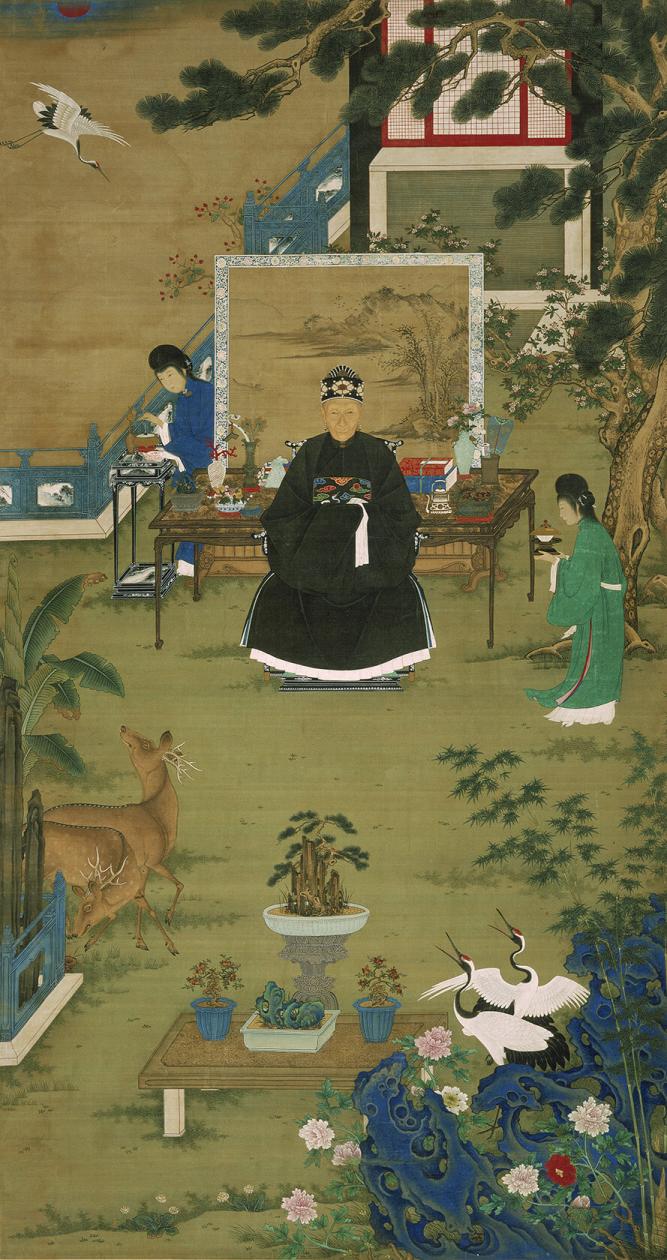
- A formal Chinese garden with cranes, deer, and a lady seated on a carved chair surrounded by servants
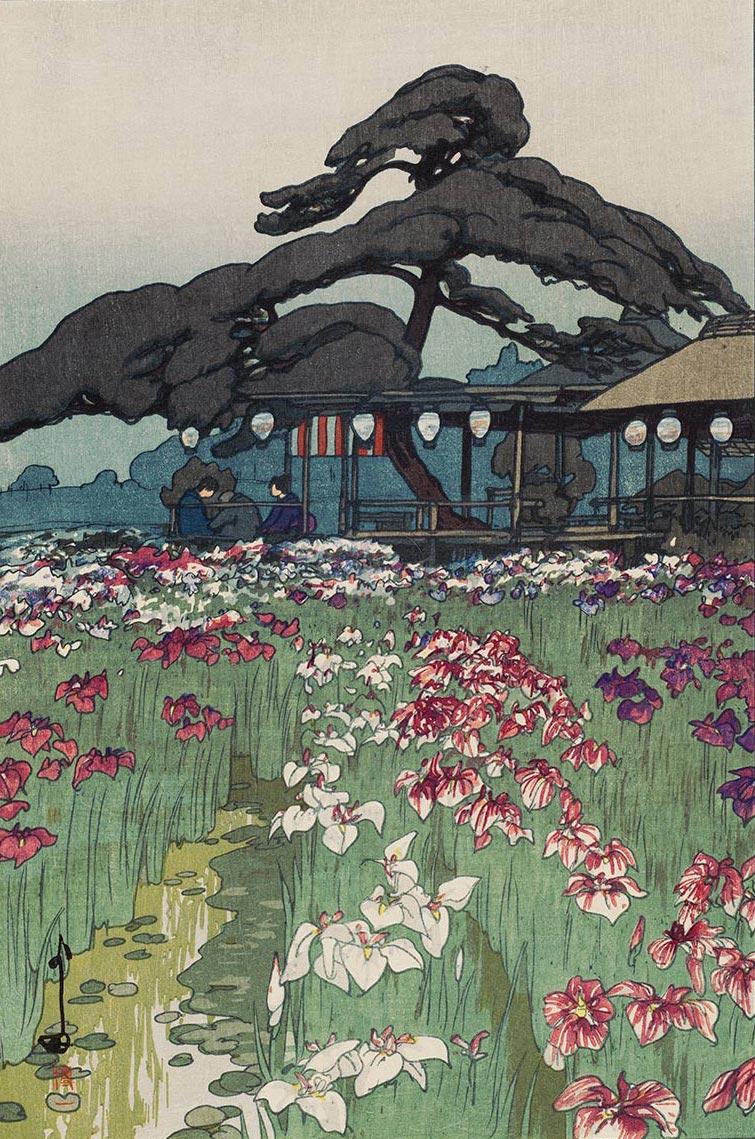
- A Japanese iris garden in full bloom, with paper lanterns and a teahouse in the distance
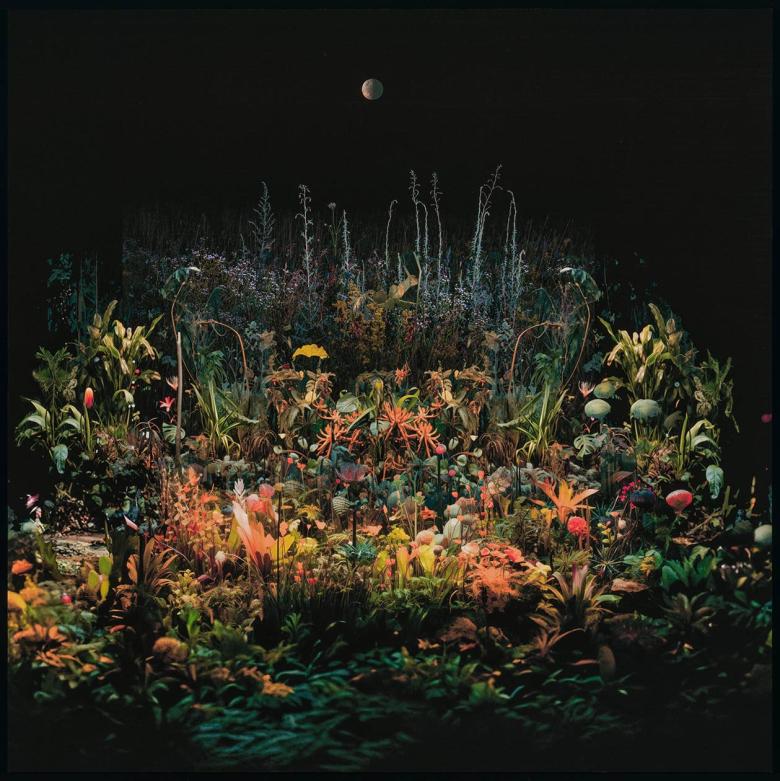
- A wild, dark garden with no paths, no fences, no people — only plants glowing under a single moon
Hold your answer. We'll come back to it at the end.
Work 1 — The Garden as Status
About the work
This painting is not really about a garden. It is about a person — a high-ranking woman of the Qing dynasty, depicted on her birthday surrounded by every symbol of longevity, virtue, and refinement that Chinese visual culture could offer.
The garden here is a stage set for identity. Every element is a coded message:
- The crane — longevity and nobility; cranes were associated with immortality and were kept in imperial gardens
- The deer — prosperity and good fortune; the Chinese word for deer sounds like the word for official salary
- The pine tree — endurance through hardship; pines stay green through winter
- The potted bonsai — cultivation, refinement, the control of nature through human skill
- The peony — wealth and high status; the "queen of flowers" in Chinese tradition
- The blue and white porcelain — scholarly taste and cosmopolitan refinement
The garden is not a place to walk through. It is a vocabulary. The artist has assembled a set of symbols around the subject to tell viewers exactly who she is and what she deserves.
Space without a vanishing point
Look at how space is constructed in this painting. There is no single vanishing point. The ground tilts upward rather than receding. Objects near the top of the painting are not smaller than objects at the bottom — they are simply higher. This is called axonometric or elevated perspective — a system used across East Asian painting for centuries, in which height on the picture surface signals distance from the viewer.
This is not a mistake or a limitation. It is a deliberate choice that allows the artist to show more: the woman and her attendants, the garden behind, the cranes on the terrace, the rock formation, all visible simultaneously — a kind of total view that linear perspective cannot offer.
- Compare this to a Western portrait you know (a king, a queen, a wealthy merchant). What symbols do Western portraits use to show status? Are any the same?
- The garden in this painting cannot be entered — there are no paths. Is it meant to be walked through, or meant to be read?
- If you were having your portrait painted today, which objects would you put around you to show who you are?
Work 2 — The Garden as Sensory Experience
About the work
Yoshida Hiroshi (1876–1950) was one of the masters of the shin-hanga ("new print") movement — a 20th-century revival of the traditional Japanese woodblock print that blended Western influences with Japanese techniques. He traveled widely, painting landscapes across Asia, Europe, and the Americas, but returned again and again to the seasonal gardens of Tokyo.
The Horikiri iris garden in eastern Tokyo was famous — a destination for Tokyoites every June, when tens of thousands of irises came into bloom. Yoshida made this print in 1928, during the early Shōwa era, when Japan was modernizing rapidly. The print is a deliberate act of preservation: a seasonal moment, a traditional garden, a gathering of people in a pavilion — all caught in the layered ink of a woodblock.
A woodblock print of this complexity required dozens of separately carved wooden blocks, one for each color, pressed in precise sequence onto the same sheet of paper. The pink irises, the white irises, the dark green stems, the blue-grey sky, the black pine — each was printed separately. The result is both flat and luminous, both graphic and atmospheric.
Depth without a vanishing point
Yoshida creates space differently from Western linear perspective. There is no vanishing point. Instead, depth is built through:
- Color density — the foreground irises are richest in color; the background fades to softer, cooler tones
- Detail gradient — individual petals are visible in the front; the back flowers become texture
- Vertical layering — the eye moves upward from flower to pavilion to tree to sky, each layer receding by rising
- Scale — the pavilion and figures are small, not because of a vanishing point, but because they are set higher in the composition
The space feels immersive and enveloping rather than tunnel-like.
Questions for looking
- This print was made in 1928 — the same year as the first talking films, the first commercial flights, and the early age of mass production. Why might an artist in 1928 choose to make a woodblock print of an iris garden?
- Look at the color palette. How many distinct colors can you count? How does Yoshida use them to control where your eye goes?
- Compare the feeling of this garden to the Chinese painting. Which feels more like a place you could actually enter? Why?
Work 3 — The Garden as Ecological Vision
About the work
Mary Mattingly (born 1978) is an American artist whose work focuses on ecological systems, survival, and the future of the natural world. Magnetic Field was made in 2023 and is one of the most recent works in the exhibition — a deliberate counterpoint to the centuries of garden imagery that surround it.
This is not a garden anyone designed. There are no paths, no gates, no benches, no human figures. The plants — from many different climates and ecosystems — grow together in a dense, glowing mass against a pure black background. A small moon (or planet) hovers in the upper left. The light source is invisible; the plants seem to generate their own luminosity.
Mattingly stages this as what she calls an "imagined ecology" — a garden that could not exist in nature, assembled from species that would never grow together, lit by no natural light. It is a photograph, but it is also a fantasy, a wish, and perhaps a warning: what if we imagined nature on its own terms, without human management, without borders, without utility?
Where the Chinese painting says the garden belongs to the person, and the Yoshida print says the garden belongs to the season, Mattingly's photograph says: the garden belongs to itself.
No perspective at all
Mattingly's composition uses neither linear perspective nor atmospheric perspective. The garden is presented as a frontal mass — it does not recede into the distance. It fills the frame from edge to edge, bottom to top. The black background removes all spatial context. There is no horizon, no ground plane, no sky.
This is a radical compositional choice: by removing perspective entirely, Mattingly removes the viewer's sense of standing outside the garden looking in. You are not a visitor. You are facing it directly, as an equal.
Questions for looking
- The moon in the upper left is very small. What does it do to the scale of the garden — does it make the garden feel larger or smaller?
- There are no human figures, no paths, no fences. What does this absence say about Mattingly's idea of what a garden should be?
- This work was made in 2023, in the context of climate change and biodiversity loss. Does knowing that change how you see it?
Human Presence — Central, Distant, Absent
In 300 years, the human figure has moved from center → edge → gone. Do you think this is progress? Or is something lost at each step?
Which of the three relationships with nature do you think is healthiest — or is there a fourth option none of these artists imagined?