Warm up-Latent Space Collage
Before we look at how a master like Manet builds a scene, we must learn to see the "DNA" of art—the individual colors, shapes, and textures that make up a masterpiece. In this activity, the AI acts as the "Digital Glue" that merges these fragments into something entirely new.
visit at least two different galleries, do Observtional drawing and collect 3–5 visual specimens.
Then we will use AI to see what happens when these hand-drawn "DNA fragments" are reassembled into a new reality.
Prompt Formula: "A surreal creature or landscape created from [Drawing 1: The Gaze], featuring the surface of [Drawing 2: The Texture], inside the shape of [Drawing 3: The Silhouette]
- Accuracy vs. Interpretation: "When you were sketching in the gallery, you chose specific lines to draw. Did the AI keep your 'important' lines, or did it focus on something you didn't expect?"
- The 'Human' Touch: "Look at your original sketch and the AI's final collage. Which one feels more like 'you'? Is it the one where your hand moved the pencil, or the one where your brain wrote the prompt?"
Street Singer(Gallery 255)
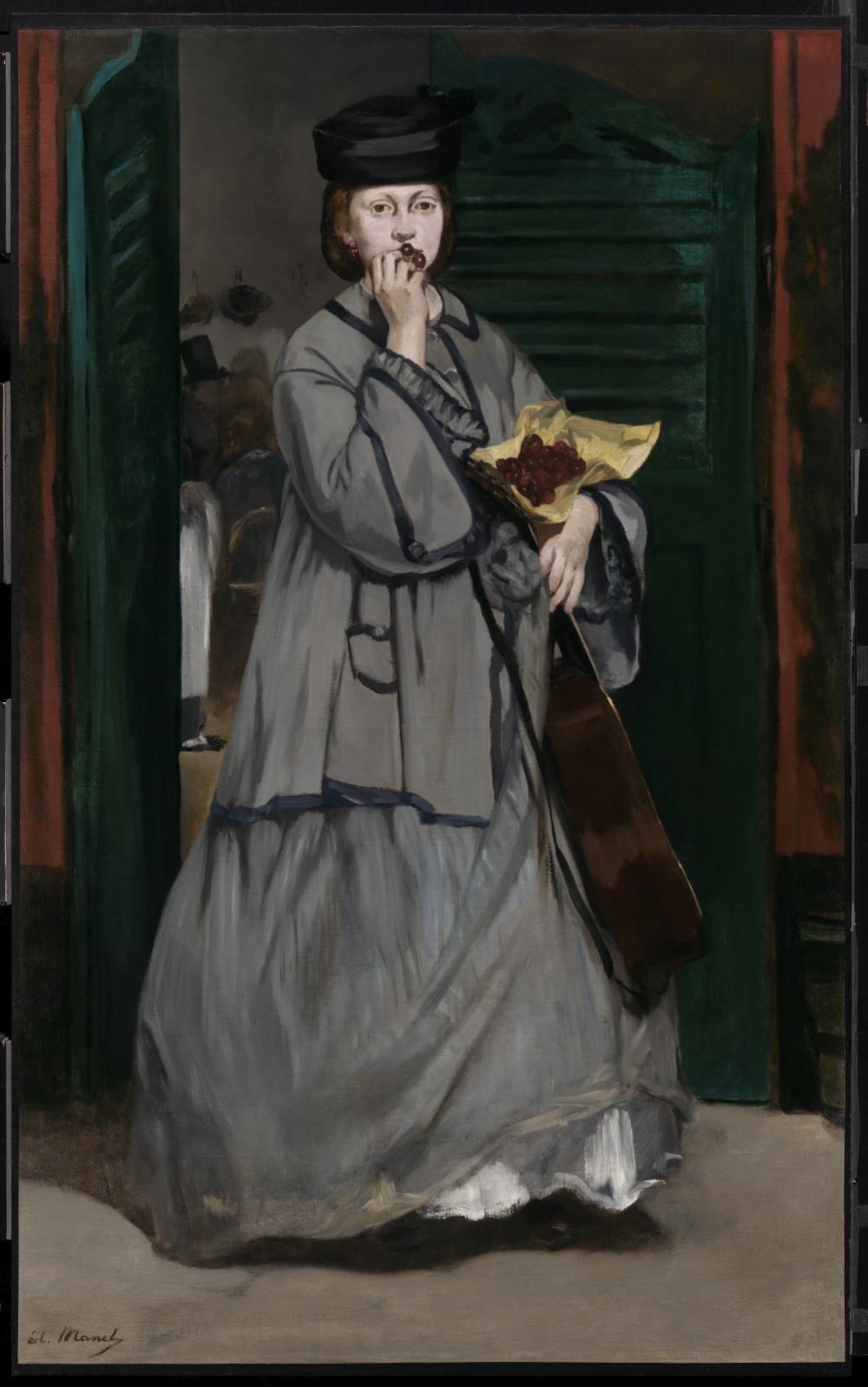
Awkwardly clutching her guitar and a parcel of cherries, a street musician hitches up her skirt to facilitate her steps as she exits a Parisian café. Manet captures the very moment she emerges: the hinged café doors have swung backward following her exit, revealing seated customers and a waiter in a crisp white apron. Antonin Proust recalled Manet, as the quintessential "flâneur," bearing witness to this scene while strolling the city streets, even allegedly asking the performer to pose for him. When she refused, Manet restaged the moment in his studio, casting in her place his favorite model, Victorine Meurent. The instantaneity of the depicted moment impelled the critic Émile Zola to commend Manet’s ability to “state frankly what he sees.” Other critics were unimpressed by Manet’s paint handling, with Paul Mantz declaring that “because of an abnormality we find deeply disturbing, the eyebrows lose their horizontal position and slide vertically down the nose, like two commas of shadow.”
Background
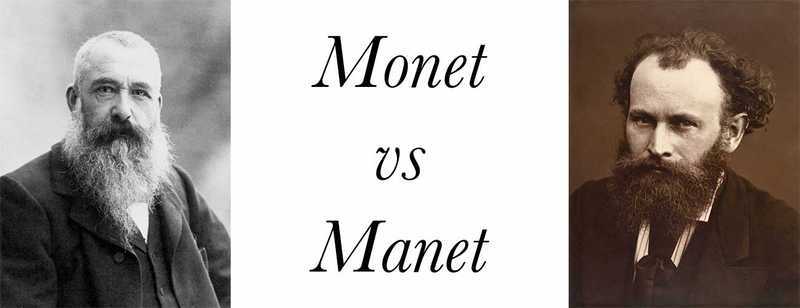
Claude MONET: The Master of Impressionism
Edouard MANET: The Bold Rebel
- The "What": Monet was obsessed with how light changes. He painted the same haystack or lily pond 20 times just to see how it looked at sunrise vs. sunset.
- The "What": Manet loved painting people in the city—at cafes, concerts, or on the street (like our Street Singer!).
- The "Style: He used tiny dabs of paint. If you stand close, it looks like a mess of dots; if you stand back, it turns into a beautiful garden.
- The "Style": He used bold black outlines and flat areas of color. He didn't care about making things look 3D and perfect; he wanted them to look "real" and modern.
- Monet is like "Environment Design" and "Lighting." He focuses on the "Where" and the "When." If you use AI to describe a Monet, you talk about shimmering reflections, fog, and golden hour.
- Manet is like "Character Design." He focuses on the "Who" and their expression. If you use AI to describe a Manet, you talk about the costume, the pose, and the gaze.
Discussion
- The "Imperfect" Moment: Discuss why this was shocking in 1862. She isn't a goddess; she’s a working-class woman exiting a café, clutching a guitar and eating cherries.
- The Flat Aesthetic: Notice the large areas of "Manet Gray." Explain how he simplified shapes, paved the way for Impressionism, and ignored traditional 3D shading.
- The Gaze: She looks directly at the viewer. Why? It creates a "confrontational" and modern feeling.
Aesthetic Juedgement
- The Cropping: "Manet cuts off the edges of the guitar and the door. Does this make you feel like you are standing right next to her, or watching from far away? How does 'zooming in' change the story?"
- The Palette: "Manet uses a lot of gray. Is this a 'sad' gray, a 'boring' gray, or a 'cool' gray? If the AI changed all the gray to bright yellow, would she still look like a street singer?"
Actibity B:The Soundscape of 1862(Cross-Modal Translation — From Visual to Auditory)
Manet doesn't just paint a figure; he captures the "ambience" of urban life in 19th-century Paris.
Prompt Keywords: 1862 Paris street ambience, rustic acoustic guitar melody, wooden carriage wheels on cobblestones, distant café chatter, subtle foley of biting a cherry, atmospheric and nostalgic.
- "What does the strumming of her guitar sound like against the stone walls?"
- "Can you hear the heavy wooden wheels of a horse carriage clattering on the cobblestones nearby?"
- "What kind of chatter and clinking glasses are coming from the dark café entrance behind her?"
- "Listen closely—can you hear the crisp 'pop' as she bites into a fresh cherry?"