How Did Artists Learn to See Depth? — A Brief History of Perspective
Before Perspective: The Medieval World (before 1400)
For over 1,000 years, European painters had no system for showing depth. In medieval paintings, figures in the background are the same size as figures in the foreground. Important figures — saints, kings, Christ — are painted large not because they are close, but because they are important. Space is symbolic, not visual.
This wasn't because medieval artists were unskilled. It was a deliberate choice: they were painting meaning, not reality. A painting was a sacred message, not a window onto the world.
Look for this: In a medieval painting, find the largest figure. Is it large because it's close — or because it matters?
The Invention of Perspective: Brunelleschi, Florence, 1415
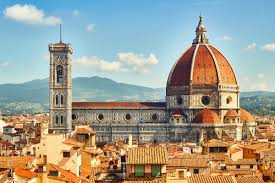
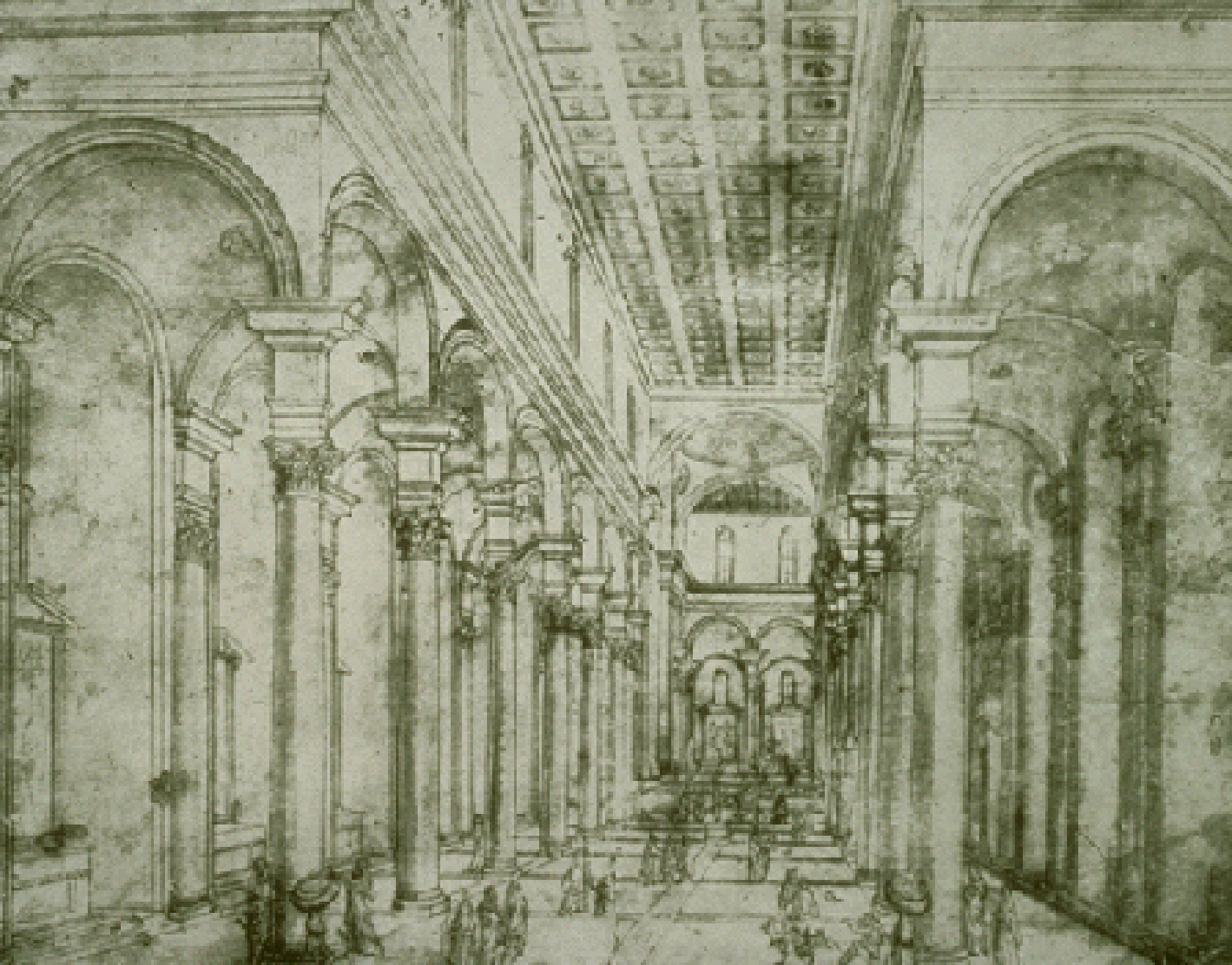
Around 1415, the Florentine architect Filippo Brunelleschi made a discovery that changed painting forever. While studying the buildings of Florence, he noticed something: parallel lines — the edges of a road, the sides of a building — appear to get closer together as they recede into the distance, until they meet at a single point on the horizon. He called this the vanishing point.
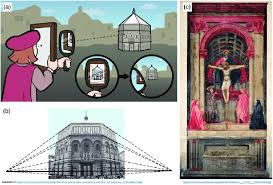
Brunelleschi ran a famous experiment: he painted the Florence Baptistery in perfect perspective on a small panel, drilled a hole through the center, and asked viewers to look through the hole at a mirror reflecting the painting. The illusion of depth was so convincing it looked like a window onto the real building. Brunelleschi had noticed that the parallel stripes of the green marble on the angled sides of the baptistery seemed to get closer together the farther away they were from the viewer. He developed a mathematical system whereby an artist could re-create this effect on a flat surface to give the illusion of distance.
Linear perspective eliminates the multiple viewpoints we see in medieval art and creates an illusion of space from a single, fixed viewpoint — suggesting a renewed focus on the individual viewer, a key part of Renaissance Humanism.
Introduction
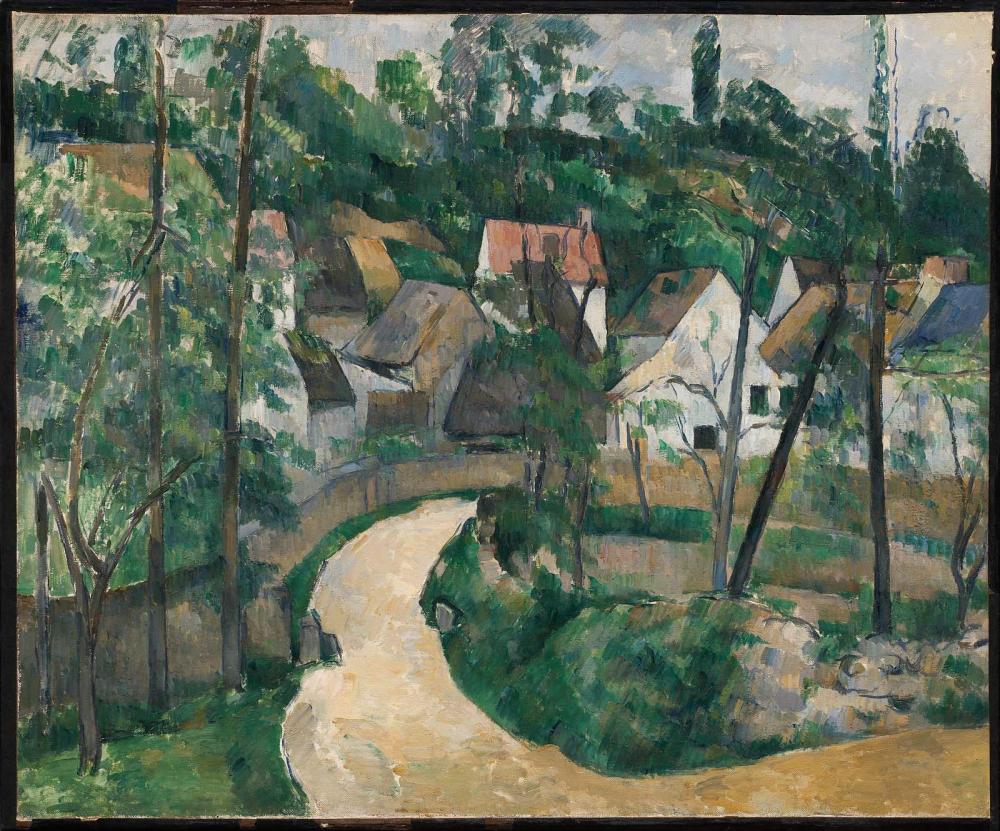
Cézanne said: "I am progressing very slowly, for nature reveals itself to me in very complex forms." He wasn't struggling with technique — he was deliberately making perspective more honest, more like how we actually see: with two eyes, in motion, never from a single fixed point.
This tension between Thaulow's confident single-point depth and Cézanne's restless two-point ambiguity is exactly what made Cézanne the father of modern art — and what later gave Picasso and the Cubists permission to abandon perspective entirely.
Abbeville (Gallery 246)
About the painting & the artist
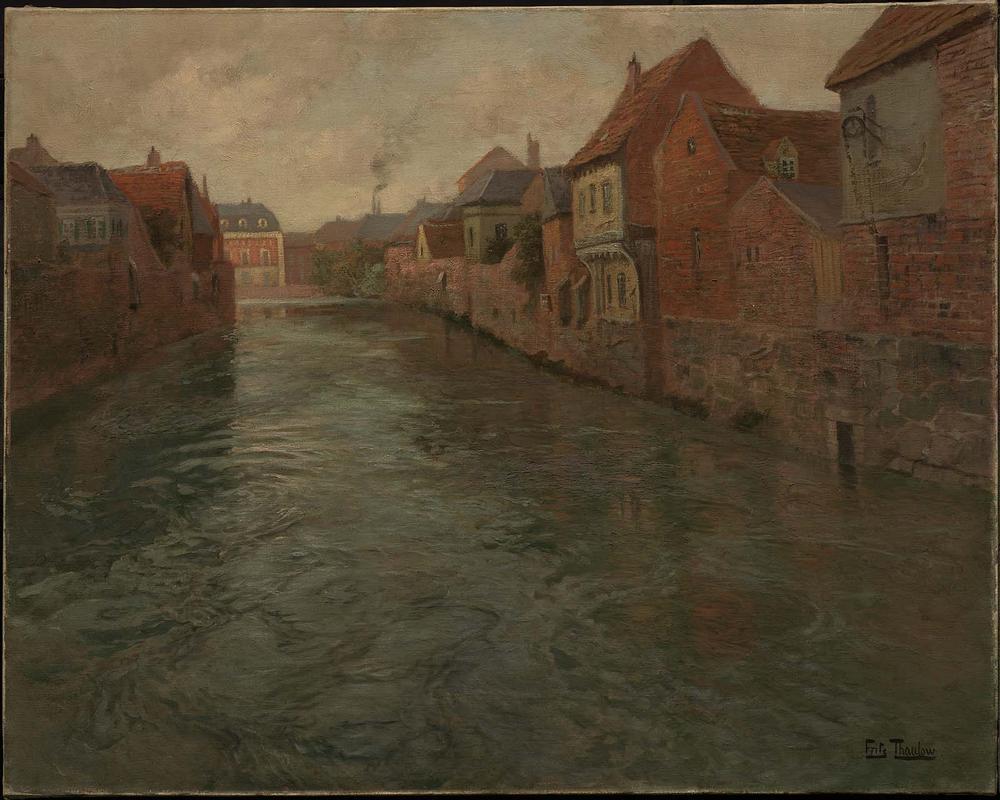
Frits Thaulow was a Norwegian Impressionist painter who moved to France in 1892 and became one of the most celebrated landscape painters of his era — counted among the friends of both Claude Monet and Auguste Rodin. He was fascinated above all by one subject: water. Rivers, canals, streams — Thaulow painted water in every light and every season, often setting up his easel directly on the riverbank to paint outdoors.
Abbeville is a small town in northern France. Thaulow painted the town’s canals and riverside streets repeatedly during his stays in the area. In this painting, the foreshortened path of the river is the main element of the composition, with the play of light on water the central concern. Buildings line both banks, their reflections broken by the gentle movement of the current. The eye is pulled naturally down the canal toward the far distance — a textbook demonstration of one-point perspective.
Questions for looking
- If you stood at the edge of this canal, where would you be standing? Where is the painter standing?
- Thaulow painted this on location — outside, in real weather, in front of the real canal. How does that change what he chose to paint compared to a studio painter?
- The sky is reflected in the water. Find two places where the reflection is sharp and two where it is broken. What causes the difference?
- Thaulow’s brushstrokes create a sense of movement — the painting invites viewers to experience the scene as if they were there. Where in the painting do you feel most like you are standing on the riverbank? What specifically creates that feeling?
Turn in the Road(Gallery 258)
About the painting & the artist
Paul Cézanne is widely regarded as the first truly modern artist — the painter who stood between Impressionism and everything that came after it. He spent years being rejected by exhibition committees and misunderstood by critics, but his colleagues — including Claude Monet. The first owner of this very painting — recognized that he was doing something no one else dared.
Where the Impressionists dissolved form into light and atmosphere, Cézanne wanted to make something more solid, more structural. In Turn in the Road, the curving road and multiple angles of the buildings evoke the winding streets of a small French town, making this cityscape realistic but subtly distorted. Multiple vantage points are shown at once, giving the composition the feeling that we are moving through it.
This painting once belonged to Claude Monet. After Cézanne’s death in 1906, Picasso and Braque credited him as the direct inspiration for Cubism — the movement that finally abandoned perspective altogether.