Introduction
This class uses a single Calder mobile as the subject for learning Design Thinking — a five-stage framework used by designers, engineers, and product teams worldwide. We apply the same five questions twice: first to understand a work of art, then to design a gift shop product inspired by it.
Who is Alexander Calder?
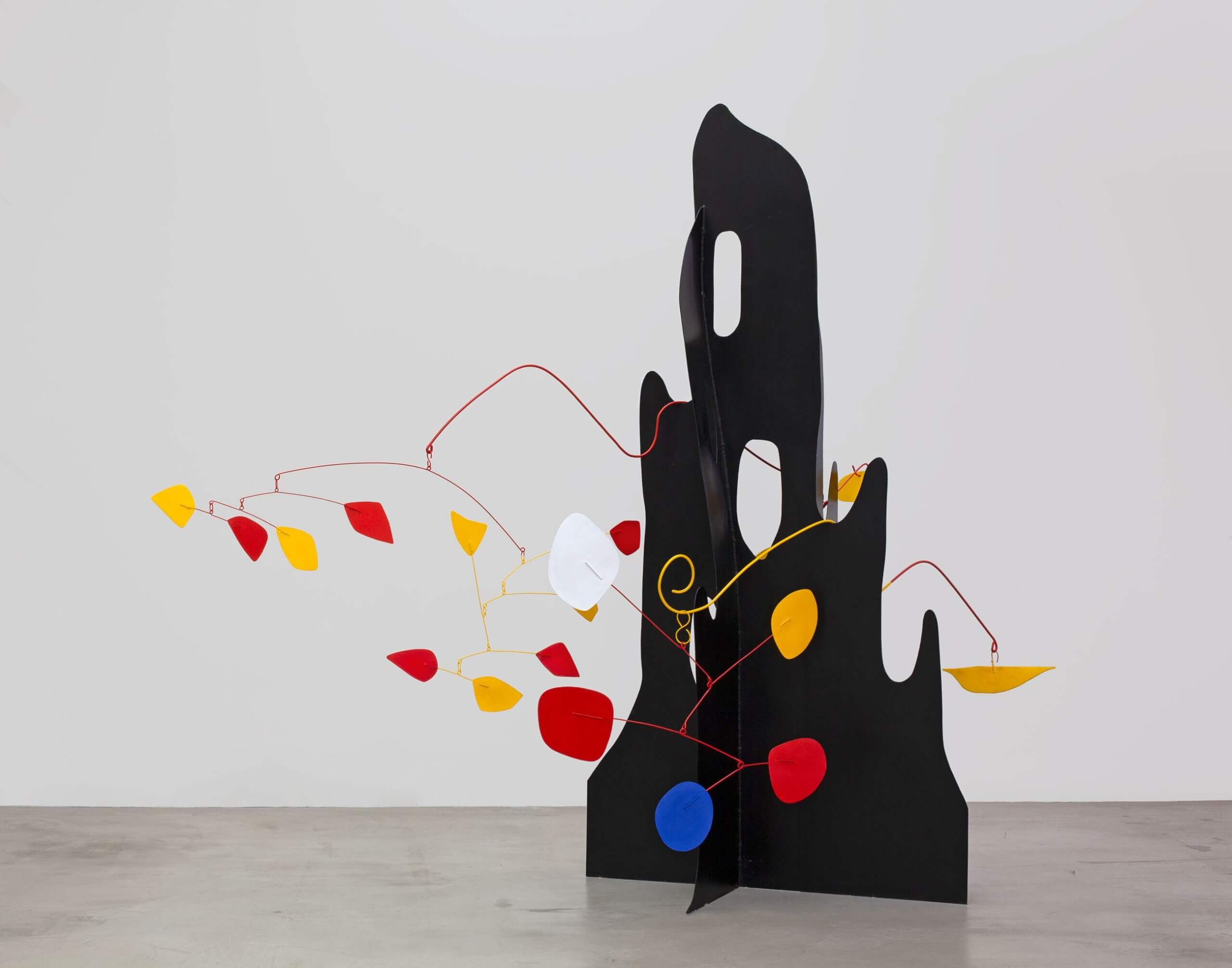
Alexander Calder (1898–1976) was an American sculptor who invented the mobile — the hanging, moving sculpture we know today. The word "mobile" was coined by Marcel Duchamp in 1932 specifically to describe Calder's work. Before Calder, sculpture didn't move.
He trained as a mechanical engineer before becoming an artist — which is why his mobiles work so precisely. He understood weight, balance, and physics before he understood painting. The wires, pivots, and joints in his sculptures are never hidden: they are part of the artwork.
Calder limited himself to four colors only: red, yellow, blue, and black (sometimes white). For Calder, color was emotion — not decoration.
His shapes look abstract but often suggest organic forms: leaves, planets, birds, constellations. He said: "I want to make things that are fun to look at — that have no propaganda."
Most importantly: air is his collaborator. Calder accepted that his mobiles would never move the same way twice. Time is built into the artwork — the sculpture reveals itself slowly, never all at once.
How Did Calder Discover the Mobile?
The mobile wasn't a sudden invention. It came from three moments of looking — each one a case of observation changing everything. This is Calder's own Design Thinking process, before the term existed.
Moment 1 · The Circus, New York, 1925
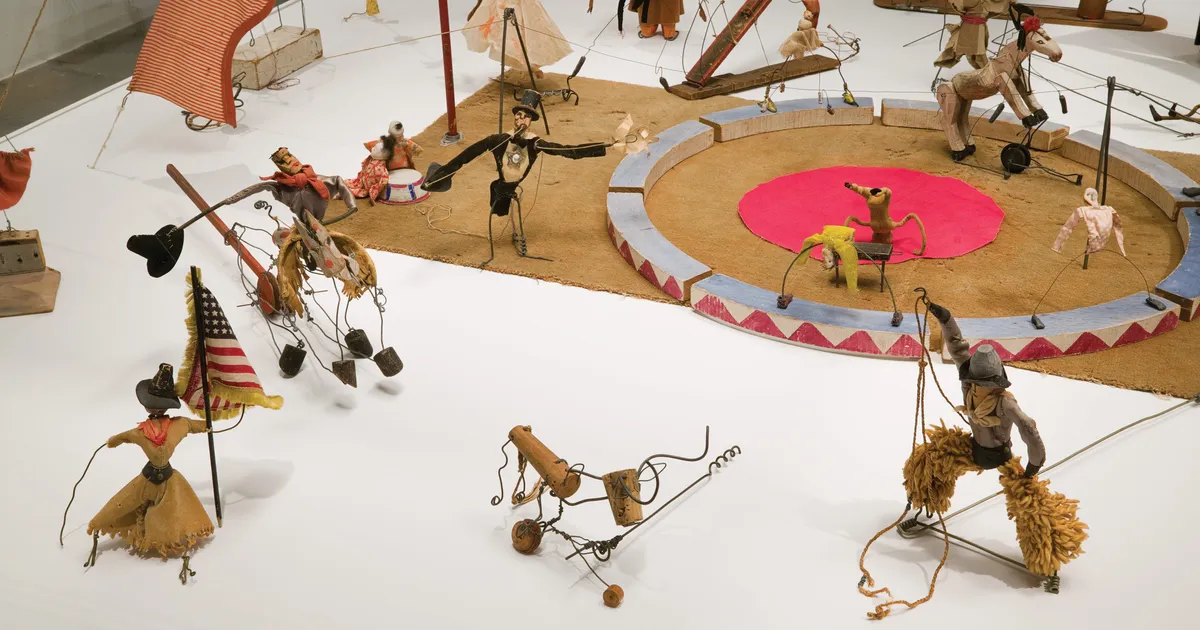
Empathize — observing movement
Calder was working as an illustrator for a newspaper when his editor sent him to sketch the Ringling Bros. and Barnum & Bailey Circus. He was supposed to draw for two hours. He stayed for two weeks.
What fascinated him wasn't the performers — it was the space and the movement. Acrobats flying through air. A tightrope walker calibrating weight with every step. Jugglers turning chaos into rhythm. He later said: "I love the space of the circus. The whole thing of the vast space — I've always loved it."
After moving to Paris in 1926, he spent five years building Cirque Calder — a miniature circus made from wire, cork, cloth, and found objects, with over 200 tiny figures. He performed it himself, controlling every acrobat by hand. This wasn't just art — it was engineering research. Every performance taught him more about the physics of objects in motion: balance, weight, momentum, and the role of chance when a figure didn't land quite as planned.
Moment 2 · Mondrian's Studio, Paris, 1930
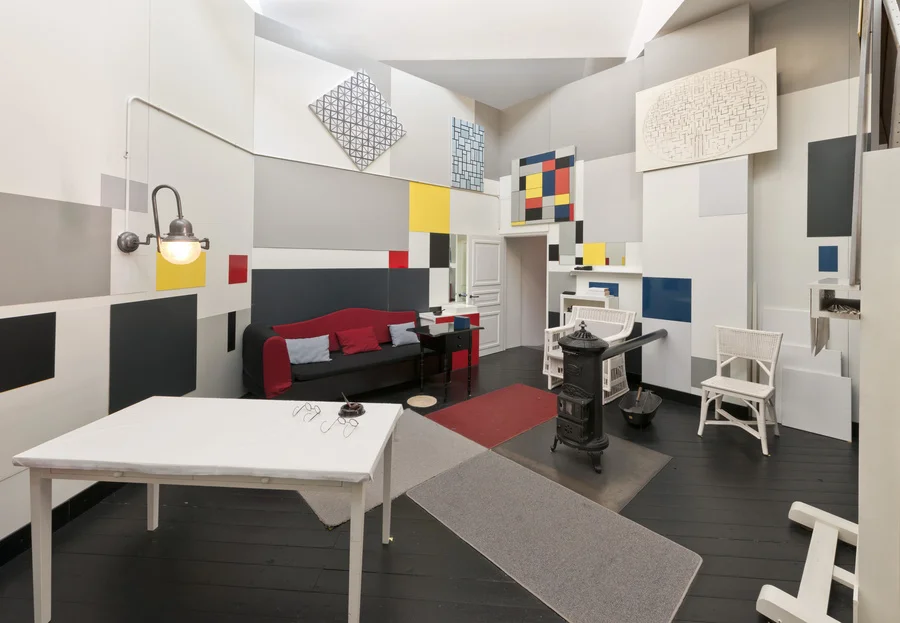
Define + Ideate — one rejected idea that started everything
In October 1930, Calder visited the Paris studio of Piet Mondrian — the Dutch painter known for his grid paintings of red, yellow, and blue rectangles. He later described what he saw:
"It was a very exciting room. Light came in from the left and from the right, and on the solid wall between the windows there were experimental stunts with colored rectangles of cardboard tacked on…"
Standing there, looking at those colored squares, Calder had an idea. He turned to Mondrian and said: "Perhaps it would be fun to make these rectangles oscillate."
Mondrian looked at him seriously and replied: "No, it is not necessary. My painting is already very fast."
Mondrian said no. But Calder walked away electrified. He later wrote that this visit gave him "a shock that started things." He thought: if Mondrian won't make his paintings move — I will make something that does. He went home and began making abstract sculptures that moved.
Moment 3 · Letting Go of the Motor, 1932
Prototype + Test — the constraint that became the signature
Calder's first moving sculptures were driven by electric motors. They moved, but they moved the same way every time — predictable, mechanical, clockwork. He quickly realized this was wrong. A motor-driven sculpture wasn't alive. It was a machine.
So he made a decision that seemed like a limitation but became his greatest strength: he took out the motors and let air do the work.
This meant he could no longer control what his sculptures did. Every breath of wind, every person walking past, every change in temperature would create a different composition. The sculpture would never look exactly the same twice. He accepted this — and called it a feature, not a flaw.
The philosopher Jean-Paul Sartre described it perfectly: "The forces at work are too numerous and complicated for any human mind, even that of their creator, to foresee all their combinations. For each of them Calder establishes a general fated course of movement, then abandons them to it: time, sun, heat and wind will determine each particular dance."
Looking at the Mobile Gallery 258 and Gallery 332

Dimension 1 · Visual — Shape, Color, Balance
Spend 3 minutes in silence. Sketch the one shape you would want to cut out and keep. Identify Calder's palette: which of the four colors appear? Where is the visual weight — left, right, or center?
Dimension 2 · Motion — Movement, Time, Chance
Watch the mobile — or imagine it moving. If you filmed it for one minute, would any two frames look exactly the same? Calder said his mobiles complete themselves through air. Is unpredictability a flaw or a feature?
Dimension 3 · Narrative — Meaning, Metaphor, Story
The MFA mobile is called Untitled. Give it your own title. Then write one sentence — the back-cover blurb if this mobile were a book. Compare titles with the person next to you: how different can the same object's story be?
Dimension 4 · Emotion — Mood, Personal Response
One word for the feeling the mobile gives you. One sentence explaining why. Then: if this mobile had a sound, what would it be — a song, a sound effect, a piece of music?
Dimension 5 · Design Logic — Material, Constraint, Process
Calder cut shapes from sheet metal with a blowtorch, then painted them flat. He calibrated weight with wire. What rules did he set for himself — and how did those rules become his signature?
What is Design Thinking?
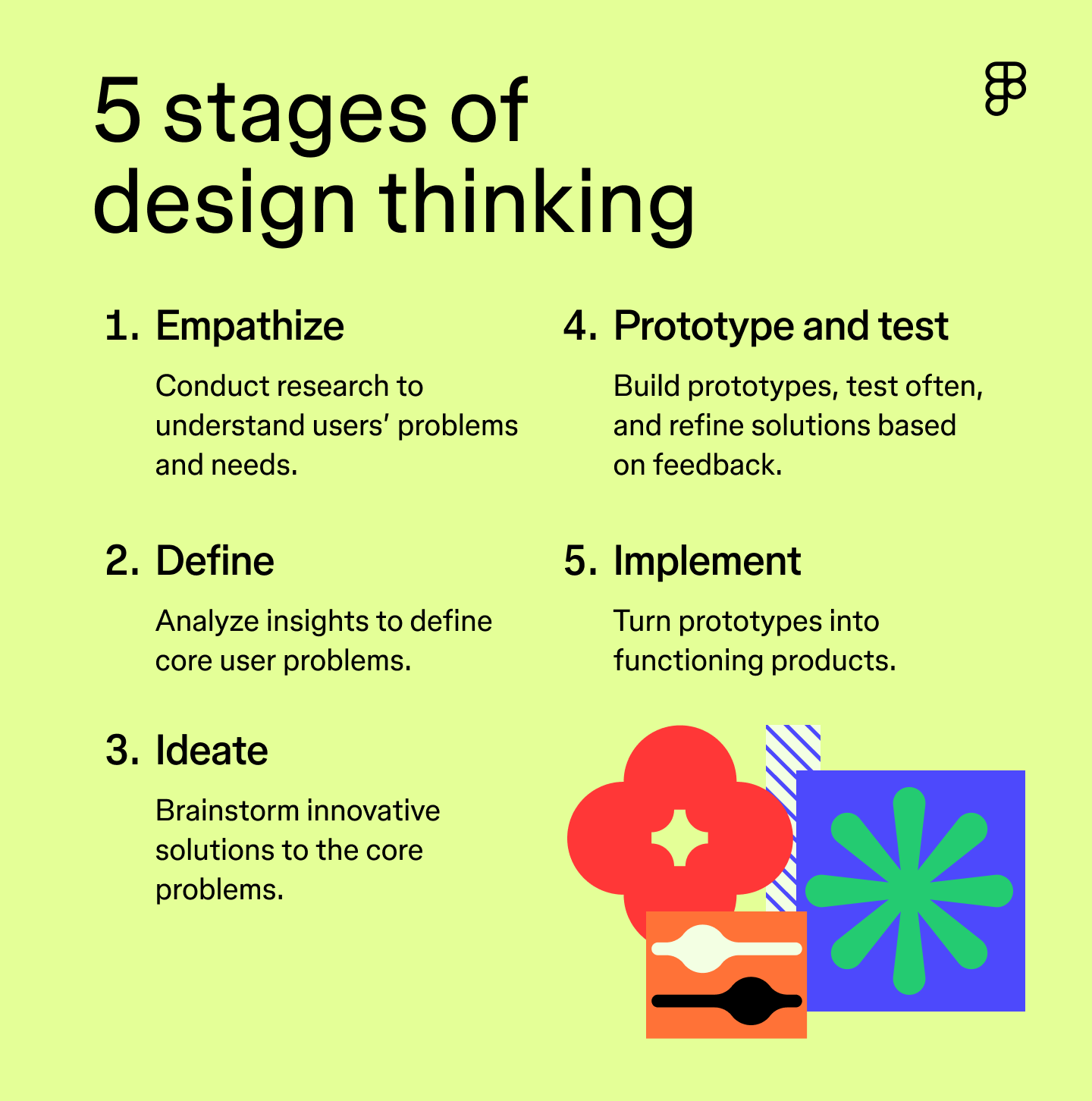
Design Thinking is a five-stage framework for creative problem solving. It was developed at Stanford's d.school and is used by companies like Apple, IDEO, and Airbnb to design products people actually want.
The five stages are not steps in a fixed order — you can move back to any stage at any time. The process is iterative. The goal is always the user.
| Stage | Question | What you're doing |
|---|---|---|
| 1 · Empathize | Who is this for? What do they feel? | Observe and listen without judgment |
| 2 · Define | What is the real challenge here? | Frame the problem clearly |
| 3 · Ideate | What are all the possible ideas? | Generate broadly — quantity first, no judgment |
| 4 · Prototype | What does a rough version look like? | Build something fast to make thinking visible |
| 5 · Test | Does it work for the user? | Get real feedback and iterate |
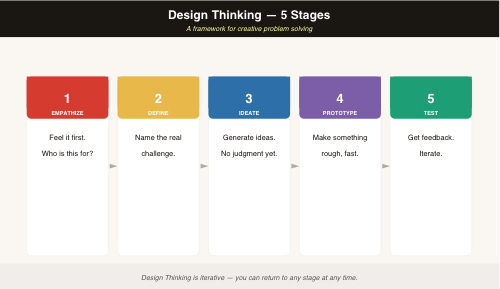 Shared in class
Two Tracks, One Framework
Today we use Design Thinking in two parallel tracks — first to analyse Calder's mobile, then to design a product.
Track A — Analyse the artwork
You are the user. Stand in front of the mobile and move through each stage.
- Empathize — Stand in silence for 3 minutes. What does the mobile make you feel? What do you notice first?
- Define — Which one dimension matters most to you: the visual, the motion, the narrative, the emotion, or the design logic? Name it.
- Ideate — Give the mobile your own title. Write 3 completely different one-sentence stories it could be telling.
- Prototype — Sketch the one shape you would take home. What could it become?
- Test — Share your title and story with the person next to you. Do they feel what you felt?
Track B — Design a product
The gift shop visitor is your user. Apply the same five stages.
- Empathize — Who buys things in a museum gift shop? What do they want to feel when they leave?
- Define — What is the ONE thing your product needs to communicate?
- Ideate — Using Calder's rules — 4 colors, flat shapes, asymmetric balance — generate as many product ideas as you can. No editing yet.
- Prototype — Sketch your strongest concept on kraft paper. Add a one-sentence product description.
- Test — 30-second pitch to the group. Would someone buy this? Why or why not?
Where Does AI Fit In?
AI is a thinking partner — not an answer machine. In each stage of Design Thinking, AI plays a different role.
→ See Diagram 3: Where Does AI Fit In?
| Stage | Who leads | AI's role | Sample prompt |
|---|---|---|---|
| Empathize | You | AI can describe facts, but only you can feel something standing in front of the work. | "Tell me 3 things a visitor might feel seeing this mobile for the first time." |
| Define | You + AI | You've experienced the work. AI helps you articulate what matters most. | "I felt [emotion] looking at Calder's mobile. What design problem does that suggest?" |
| Ideate | AI expands, you filter | This is where AI adds most value — fast, broad, without judgment. | "Give me 10 gift shop product concepts inspired by Calder's use of balance and primary colors." |
| Prototype | You+AI | Sketching is physical thinking. AI cannot hold a pencil or feel whether a composition works. | "Describe my product in one sentence for the manufacturer." |
| Test | You | Real feedback comes from real people. AI can help you prepare better questions. | "What questions should I ask to find out if my product design is working?" |
Research question: What did the AI say that surprised you — and what did it get completely wrong? That gap is the most interesting finding of this class.
The Design Brief
After completing both tracks, produce your final concept:
- Sketch of the product — pencil + black fine-liner only
- Palette — maximum 4 colors; at least one must be red, yellow, blue, or black (Calder's rule)
- One sentence — what does this product make someone feel?
- Your user — who is this for, and what do they want?
- Which DT stage gave you the most important insight